Food
Live or frozen food, which should you choose?
Lire l'article
Equipement
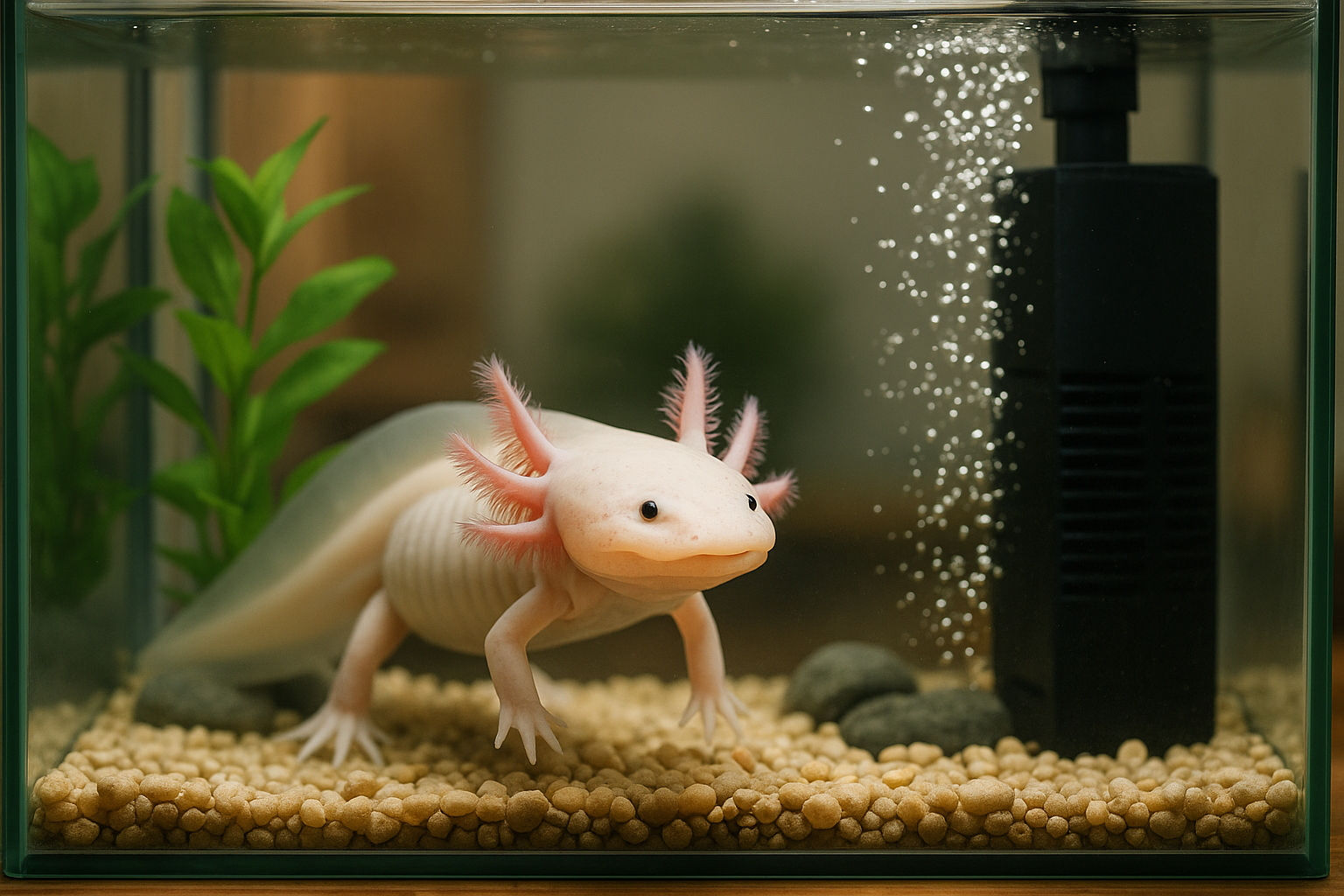
When setting up an aquarium for an axolotl, one of the first questions that often comes up is: do you absolutely need a filter? Some people say an axolotl can live without one, while others swear by strong filtration. So who’s right? And more importantly, how do you make the best choice for your animal’s well-being?
A filter doesn’t just make the water look “cleaner.” Its role is far more crucial:
Without a filter, ammonia and nitrite levels can quickly rise to toxic concentrations. The water may look clear but still be deadly for your amphibian.
Yes — but it requires strict discipline and intensive maintenance:
This approach can work in a very large, lightly stocked tank with natural plants and an experienced aquarist. But in 99 % of cases, a filter is strongly recommended, especially for beginners.
The choice of filter depends on several factors: tank size, budget, and your preference for aesthetics or discretion. What matters is that it meets two key axolotl requirements:
Practical and inexpensive, suitable for smaller aquariums (80–120 L). You often need to make small adjustments to reduce flow (pierced tubing, sponge on the outlet…). Their main drawback is the space they take inside the tank.
Ideal for larger tanks. Placed outside the aquarium, they save space and often provide better filtration quality. Be sure to direct the outlet flow so it does not create too much turbulence.
Very gentle and quiet, these are sometimes used for juveniles or breeding tanks. Their efficiency is limited, but they can be suitable as a supplement or for secondary tanks.
Axolotls hate being constantly pushed around by strong water movement. This can cause stress, refusal to eat or injuries from bumping into decorations. Here are some simple tips:
If the current remains too strong, choose a model with adjustable flow or reduce it mechanically with a valve.
A filter that is too powerful or poorly placed may cause visible signs in your axolotl:
In that case, act quickly to adjust the flow or change the model. Chronic stress is a major factor in amphibian illness.
A poorly maintained filter can become a breeding ground for harmful bacteria. Follow these simple rules:
A properly maintained filter ensures stable water quality, which is essential for an axolotl’s health.
A filter is not optional: it is a key tool for keeping your axolotl’s environment stable, healthy and low-stress. Although a no-filter setup is theoretically possible, it is complex and risky. It’s better to invest in gentle, well-adapted filtration and spend your time observing and caring for your aquatic companion.
Food
Lire l'article
Pratique
Lire l'article
Equipement
Lire l'article
Equipement
Lire l'article
Food
Lire l'article